Suffolk & Nassau County, Long Island
Commercial Tree Service for Property Managers & Boards
Big Brothers Tree Service works with property managers, HOAs, co-op and condo boards, municipalities, developers, and general contractors across Suffolk and Nassau County who need a tree contractor that shows up on schedule, documents the work properly, and doesn't disrupt tenants or residents in the process. We're licensed and insured, and we structure our commercial work around how property managers and boards actually operate — proposals that go to a board for approval, invoicing that fits your accounts payable process, and paperwork that satisfies your insurance requirements without back-and-forth.
Call (631) 873-1596If you manage a single property or a multi-property portfolio, call (631) 873-1596 or email sales@bigbrotreeservice.com to set up a site walkthrough and get on our schedule for routine maintenance or a one-time project.
Insurance, W-9, and Paperwork Ready to Go
We understand that before we're allowed on a property, most management companies and boards require a certificate of insurance (COI) issued directly to the property, naming the HOA, condo association, management company, or ownership entity as additional insured. We provide this as a standard part of onboarding — no chasing us down after the fact. We also keep a current W-9 on file and can send it over as soon as you need it for your vendor setup.
For municipalities and general contractors that require specific insurance limits, additional endorsements, or a signed vendor agreement before work begins, let us know your requirements up front and we'll get the documentation squared away before we schedule anything.
Invoicing, Net-30, and Purchase Orders
We work with net-30 invoicing terms for established commercial accounts and can invoice against a purchase order number when your organization requires one for its approval workflow. Invoices are itemized by task and location so your finance team or board treasurer can see exactly what was done and where, which matters most on multi-property portfolios where costs need to be tracked and allocated correctly across different addresses.
For larger projects — a hazardous tree removal, a season of scheduled pruning across several properties, or storm cleanup — we provide a written itemized proposal broken out by line item so it can go straight into a board meeting for approval, rather than a vague lump-sum quote that raises questions.
Scheduled Maintenance Contracts
Many of our commercial clients set up a scheduled maintenance contract covering routine pruning, deadwood removal, and canopy management across the year rather than calling us reactively every time something looks off. This works well for HOAs and condo communities with common-area trees, corporate campuses, and multi-building portfolios where a predictable maintenance cadence is easier to budget than one-off calls.
A typical contract lays out how many visits per year, what's covered at each visit, and pricing locked in for the term, so your board or ownership group isn't re-negotiating scope every time a tree needs attention. We'll build the schedule around your property's specific tree inventory and past problem spots.
Off-Hours Scheduling and Tenant Disruption
Commercial properties, apartment complexes, and condo communities can't just shut down foot traffic and parking whenever tree work needs to happen. We regularly schedule work during off-hours, early mornings, or weekends specifically to avoid disrupting tenants, residents, retail customers, or business operations during peak hours. If your property has specific quiet hours, lease restrictions, or resident notification requirements, tell us during the walkthrough and we'll plan the work window around them.
For active retail centers or office parks, we can also phase work across sections of a lot so parking and access aren't fully blocked at once — useful for larger properties where closing an entire lot isn't an option.
Site Safety and Traffic Control
Any tree work near a parking lot, drive aisle, sidewalk, or roadway needs proper traffic control and site safety measures, and we set these up as standard practice on commercial jobs — cones, barricades, signage, and spotters where needed to keep pedestrians and vehicles clear of the work zone. For properties with heavier traffic patterns or municipal roadway frontage, we can coordinate lane closures or flagging as required.
We also carry the equipment to work safely around parked cars, building facades, and shared amenities like pools or playgrounds that are common on multi-family and HOA properties, minimizing the footprint of each job site.
Storm Response for Contract Clients
After a significant storm, tree service demand across Long Island spikes fast, and properties without an existing relationship often end up waiting. Clients on a scheduled maintenance contract or standing service agreement with us get priority scheduling for storm response — downed limbs, split trees, and debris blocking access are the kind of issues that can't wait for a normal work order cycle, and we prioritize our contract clients accordingly when storm call volume is high.
If storm response time matters to your property — say you manage a complex with limited emergency vehicle access or a municipal parcel with public safety concerns — a standing agreement is worth setting up before storm season rather than after.
Parking Lots, Sight Lines, and ADA-Related Clearance
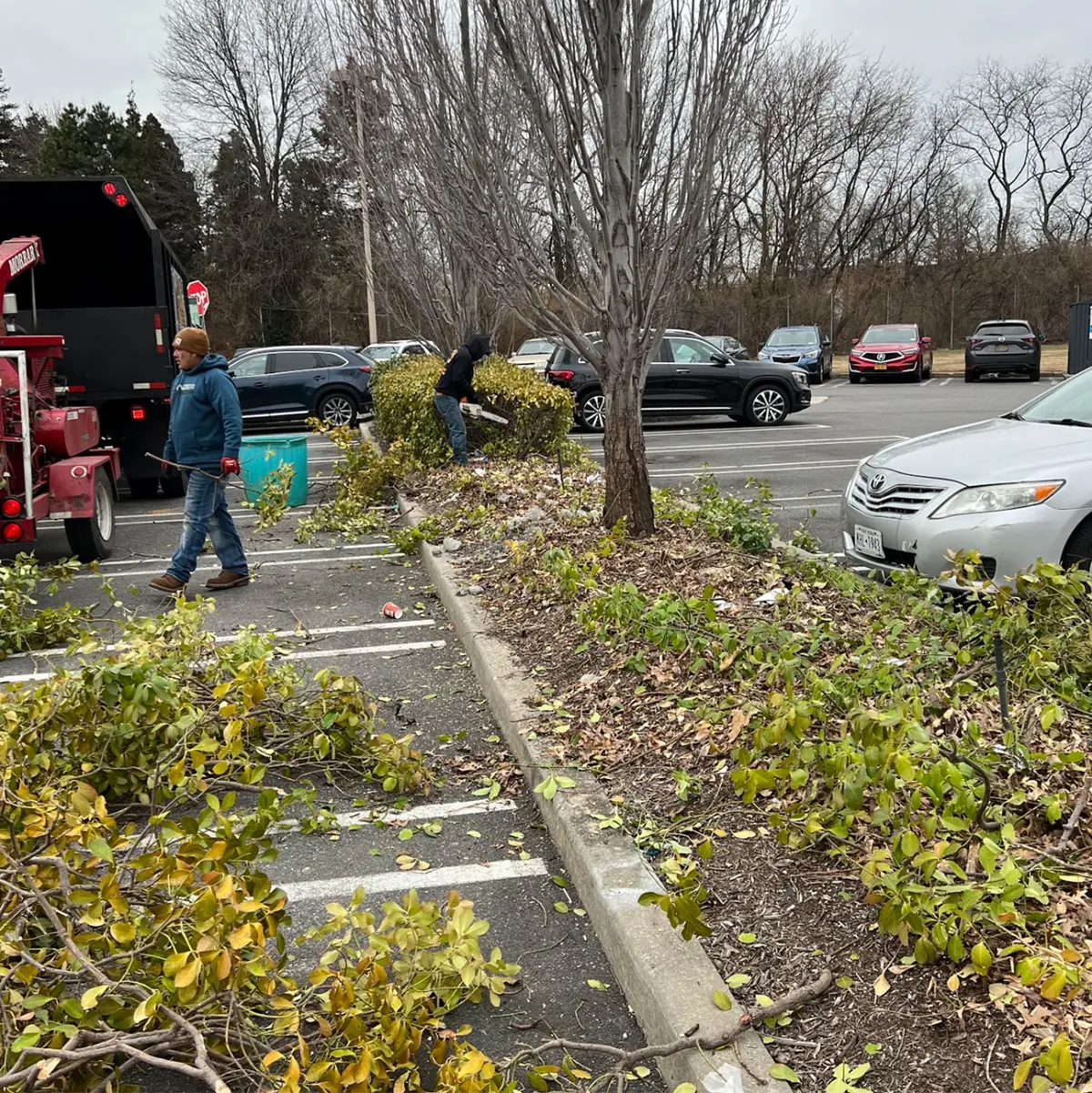
Parking lot islands are one of the most common commercial tree headaches — trees planted decades ago in small islands now have roots heaving pavement and canopies hanging low over parked cars. We handle both the pruning to keep canopies clear of vehicles and, where roots have become a liability, coordinate removal and replacement planting.
We also handle sight-line and signage clearance so your monument sign, building signage, and traffic sight lines at entrances and exits stay visible, which matters for both safety and code compliance. Canopy over walkways gets raised to maintain clearance for pedestrians and, where applicable, to keep ADA-required path widths and headroom clear along accessible routes — an issue we regularly find on older properties where trees have grown into the walkway zone over the years.
Annual Hazard Tree Inspections
For portfolios and larger properties, we offer an annual walkthrough to flag hazard trees before they become emergencies — dead or dying trees, storm-damaged limbs, trees leaning toward buildings or parking areas, and root issues affecting pavement or foundations. We provide a written summary with photos and recommended priority so your board or management team can budget and plan the work rather than reacting to a failure.
This kind of proactive inspection is also useful documentation to have on file in case a tree-related liability question ever comes up on the property.
Frequently Asked Questions
Can you provide a certificate of insurance naming our HOA as additional insured?
Yes, providing a COI issued to the property with the association, management company, or ownership entity named as additional insured is standard for our commercial onboarding. We can send it as soon as we have the correct entity name and address.
Do you invoice on net-30 terms?
Yes, we offer net-30 invoicing for established commercial accounts, and we can invoice against a purchase order number if your organization requires one for its approval process.
Can you provide a written proposal for board approval?
Yes, for any sizable project we provide an itemized written proposal broken down by task and cost so it's ready to bring directly to a board meeting for a vote.
Do you offer scheduled maintenance contracts for multiple properties?
Yes, we set up scheduled maintenance contracts covering routine pruning and inspections across single properties or full portfolios, with pricing and visit frequency defined for the term of the agreement.
Can you schedule work during off-hours or weekends to avoid disrupting tenants?
Yes, we regularly schedule commercial work during off-peak hours, early mornings, or weekends specifically to minimize disruption to tenants, residents, and customers.
Do contract clients get priority during storm cleanup?
Yes, properties with a standing maintenance contract or service agreement receive priority scheduling for storm response over new, one-time callers, since storm demand can spike quickly across Long Island.
Do you handle sight-line clearance and ADA-related canopy clearance over walkways?
Yes, we regularly prune to maintain sight lines around signage and entrances and raise canopy over walkways to preserve pedestrian clearance and accessible path widths on commercial and multi-family properties.