Suffolk & Nassau County, Long Island
What Tree Removal Costs on Long Island
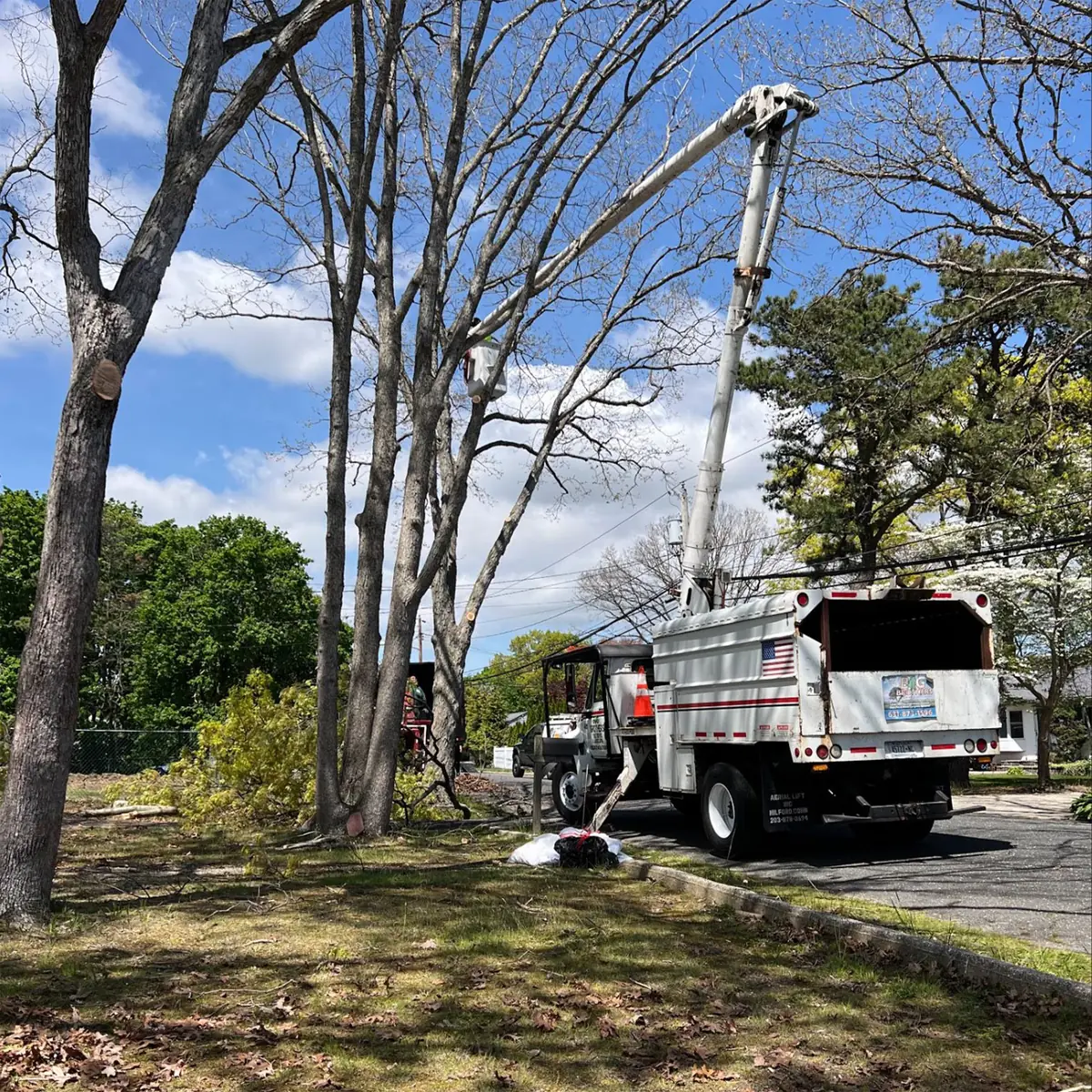
The honest answer is that most standard residential tree removals on Long Island land somewhere between a few hundred dollars and about two thousand, and the spread inside that range has almost nothing to do with how tall the tree is. It comes down to what is underneath it. A sixty-foot oak in an open front yard with room to fell it is a straightforward morning. The same tree in a fenced backyard, over a pool, with a neighbor's garage twelve feet away, is a full day of rigging with a crew of four.
Call (631) 873-1596That is why two companies can quote the same tree and be eight hundred dollars apart, and why nobody who is being straight with you will give you a firm number over the phone without seeing the tree or at least a few photos. Below is what actually drives the price, so you can read your own quotes with some idea of what you are looking at.
The four things that actually set the price
Size is only the starting point. Once we are on site, the number moves based on four factors, roughly in order of how much they matter:
- Access — can equipment reach the tree, or does everything come out by hand through a 36-inch gate? This is the single biggest swing factor on Long Island's tight lots.
- Drop zone — is there open ground to fell into, or does the tree have to come down in rigged sections lowered by rope? Sectional removal can double the labour hours on the same tree.
- What is underneath — a roof, a pool, a bulkhead, a septic field, or a neighbour's fence all mean slower, more careful work and more rigging.
- Species and condition — a dead, brittle tree is more dangerous and sometimes more expensive than a healthy one of the same size, because it cannot be climbed safely and may need a bucket or crane.
Rough ranges by tree size
These are general figures for a standard residential removal with reasonable access, including cleanup and hauling. Treat them as a starting point, not a quote — access and drop zone can move any of these substantially.
- Small trees under about 25 feet — often a few hundred dollars. Ornamentals, small maples, a dead Bradford pear.
- Medium trees, roughly 25 to 50 feet — typically several hundred to just over a thousand. Most residential maples, cherries, and mid-size pines.
- Large trees, 50 to 80 feet — commonly one to two thousand. Mature oaks fall here, and this is where rigging usually starts driving the number.
- Very large or hazardous trees over 80 feet — can run beyond two thousand, particularly with crane work or a compromised trunk.
What makes a job cost more than the size suggests
Certain Long Island situations reliably push a quote above what the trunk diameter would imply. Canal-front properties in Copiague, Lindenhurst and Wantagh are the clearest example — bulkheads and docks mean every limb gets roped and lowered rather than dropped, and there is often nowhere to stage a truck. Tight postwar lots in Bethpage and Levittown have the same problem for a different reason.
A crane pick is the other big one. When a tree overhangs a roof or pool with no clear path down, a crane is often the safest option and sometimes the only one. It costs more per day but can turn a two-day rigging job into a half-day, so it is not always the more expensive route overall. We will tell you when we think a crane makes sense and why.
Storm damage is its own category. A tree already leaning on a structure or hung up in another tree is under load, and it has to be cut in a specific order to release that tension safely. That is skilled, slow work, and it prices accordingly.
What should be included, and what usually is not
A complete removal quote should cover felling or rigging the tree, cutting it down to manageable pieces, hauling the wood and brush away, and raking the work area. If a quote is unusually low, that is often where the difference is — some outfits leave the wood stacked on your lawn or charge separately for hauling.
Stump grinding is normally quoted separately, because plenty of people want the tree gone and are happy to leave the stump. If you do want it ground, ask for it in the same visit — the equipment and travel are already covered, so it is meaningfully cheaper than calling us back for it later.
Trimming costs less than you might think
Pruning a mature tree usually falls in the few-hundred-dollar range depending on height, canopy size, and how much rigging is needed to get limbs down cleanly. Deadwooding a large oak — pulling the dead interior limbs out before a storm does it for you — is one of the better-value jobs in tree care, because it addresses the specific thing that most often causes damage.
If you are weighing pruning against removal on a tree you like, get both quoted. We would rather reduce a limb than take down a sound tree, and we will tell you honestly when trimming only delays a removal that is coming anyway.
Insurance, licensing, and why the cheapest quote is a risk
Tree work carries real liability. If an uninsured crew drops a limb through your roof, or someone is injured on your property, that can become your problem. Ask any company for proof of liability insurance and workers' compensation before they start — a legitimate operator will send it without hesitating.
This is usually where a suspiciously cheap quote comes from. Insurance, proper rigging equipment, and trained climbers are the bulk of what you are paying for on a difficult removal, and they are exactly what gets cut to reach a low number.
Does insurance cover tree removal?
Generally, homeowner's insurance covers removal when a tree has fallen on and damaged a covered structure — a house, garage, fence, or car. Policies commonly cover the cost of removing that tree, often up to a stated limit, and coverage varies by carrier.
What is usually not covered is removing a healthy or declining tree that has not fallen, or a tree that has come down in open yard without hitting anything. Preventive removal of a hazardous tree is almost always the homeowner's cost. Check with your carrier before assuming either way, and photograph the damage before anything is moved.
Getting a quote you can trust
We give free estimates and we can often quote accurately from a few clear photos — one showing the whole tree, one at the base, and one showing the access route from the street. For anything complicated we would rather come look at it.
Call (631) 873-1596 and we will give you a real range for your specific tree, tell you what is driving the number, and flag anything about the job that might change it.
Tree Removal Cost — Common Questions
How much does it cost to remove a large oak on Long Island?
Mature oaks in the 50 to 80 foot range commonly run one to two thousand dollars, with the number driven mostly by access and what sits underneath the canopy. An oak over a roof or pool with no drop zone costs more because it comes down in rigged sections rather than being felled.
Why are tree removal quotes so different from company to company?
Usually because they are pricing different amounts of work. One quote may include hauling the wood and grinding the stump while another leaves both. Insurance and crew experience also make a real difference in what a company has to charge.
Is stump grinding included in tree removal?
Normally it is quoted separately, since many people are happy to leave the stump. If you want it done, ask for it in the same visit — the equipment and travel are already on site, so it costs noticeably less than a separate trip.
Does homeowner's insurance pay for tree removal?
Typically yes when a tree has fallen on a covered structure like your house, garage, or fence, often up to a policy limit. Removing a standing hazardous tree, or one that fell in open yard without causing damage, is usually not covered. Check with your carrier.
Is it cheaper to remove a tree in winter?
Sometimes. Dormant season is generally less busy than the post-storm rush, and bare canopies can make rigging simpler. Frozen ground can also reduce lawn damage from equipment. It is worth asking about scheduling if the tree is not an immediate hazard.
Can you quote from photos?
Often, yes. Send one photo of the whole tree, one at the base, and one showing how we would get equipment in from the street, and we can usually give you a solid range. Complicated or hazardous trees we prefer to look at in person.
Do you charge for estimates?
No. Estimates are free, with no obligation. Call (631) 873-1596.